
The Wrong Word for the Job: Volume III
More missteps and misusages.


The previous “Wrong Word” installment had a theme, but feel free to file this one under “Misc.”
ALL RIGHT / ALRIGHT
In formal writing, use “all right.” If you’re filling in a speech balloon in a comic book or have created a first-person narrator who is a heavily tattooed fifteen-year-old anarcho-syndicalist graffiti artist, you might want to reach for “alright.”
If you’re texting, you can do whatever you like as long as you don’t complain when I use “all right” and periods and em dashes.
(I recently learned that holding down the hyphen button on the iPhone allows me to create a hyphen, an en dash, an em dash, or a bullet. This is my favorite development in technology since air conditioning.)
“AND/OR”
By “AND/OR,” I mean “and/or” acting as a single conjunction, as in . . .
Please refrain from wearing ballcaps, flip-flops, and/or pajama bottoms to class.
If you can replace “and/or” with “or,” as you often can, do so. The slash is not the ugliest mark of punctuation, but it would take the prize were it not for the existence of square brackets.
Although I can imagine jokes involving Boolean logic and Star Wars that feature “and/or,” I have not yet imagined a funny one.
ANXIOUS / EAGER
I limit “anxious” to situations involving anxiety even though it’s been used to mean “eager” so often for so many years that it’s not quite right to call “anxious” as “eager” an error. It sits there smirkingly in Merriam-Webster as the third definition, waiting for me to check and see if it’s still there, and I’m forced to admit that it should be there based on usage.
Accepting the legitimacy of a definition doesn’t, however, require a stylistic endorsement. Unless eagerness is mingled with anxiety, I don’t use “anxious” to mean “eager” because I can’t imagine an occasion when doing so is the best option.
Of course eagerness and anxiety can be mingled. There’s nothing wrong with writing that “Lucy was anxious to appear onstage for the first time” if Lucy was both excited and nervous about her first performance.1
But the archetypal business-email sentence, “Chet and I are anxious to meet with you tomorrow,”2 doesn’t mean to express anxiety. It doesn’t become less conversational with a revision to “eager,” and the contemporary lexicon doesn’t want for anticipatory hype talk. Chet and I can be happy to meet with you. We can look forward to it. We can foresee a state of otherworldly bliss. We can be excited, thrilled, amped, pumped, elated, jazzed, psyched, stoked, atingle, or over the friggin’ moon.
Using “anxious” to mean simply “eager” solves a problem that doesn’t exist. We should save “anxious” for times of anxiety, which will come soon enough.
CANCELED
If I were a writer alone, and not a writer who is also an editor based in the United States, I would thumb my nose and spell it “cancelled.”
Defenders of the favored American spelling can argue that it’s consistent with other trochaic (DUM-da) verbs that end in “el,” with Merriam-Webster also favoring “traveled,” “raveled,” “gaveled,” “labeled,” “libeled,” “shoveled,” “barreled,” “beveled,” “tunneled,” “marveled,” “groveled,” “pummeled,” “swiveled,” “driveled,” “sniveled,” “yodeled,” and “snorkeled.”3 I concede that they have been thorough.
But doubling up on the “l” would also honor “propelled,” “compelled,” “excelled,” “expelled,” and “repelled” along with other iambic (da-DUM) “-el” verbs. It would allow “cancelled” to live more happily with “cancellation.” It would promote harmony between words and nations.
If, then, there’s ever a revolutionary movement in my country to double up on the “l” with the past tense of “-el” trochaic verbs, I will take my place on the barricades.
CAREEN / CAREER
The classic “career” move, if we’re talking about the verb involving motion that gets confused with “careen,” is to hurtle at one’s opponent with a leveled lance, and it’s best for one to do this on horseback if one doesn’t want to seem eccentric or stupid. Merriam-Webster tells me that people career at one another pretty often in Ivanhoe, and the novel confirms this. Sir Walter has riders careering all over the place, twice with mounted armored figures charging “in full career.” He also gives us this less chivalrous sentiment, in song, from Friar Tuck:
Your knight for his lady pricks forth in career,
And is brought home at even-song prick’d through with a spear;
I confess him in haste—for his lady desires
No comfort on earth save the Barefooted Friar’s.
To “career,” though, doesn’t require a horse or pricking through someone with a spear. What it requires is moving rapidly in a way that is forceful, probably headlong, and possibly reckless or not entirely in control. A runaway wagon can career downhill. A car can career toward a guardrail or off a cliff after taking a curve too fast. (Note how the bending roadway makes continuing headlong unadvisable, which means that it’s possible for a finicky writer to choose “career” over the usually preferred “careen” for a certain kind of auto accident.) If I’m very hungry, I can career—and have careered—toward a buffet table.
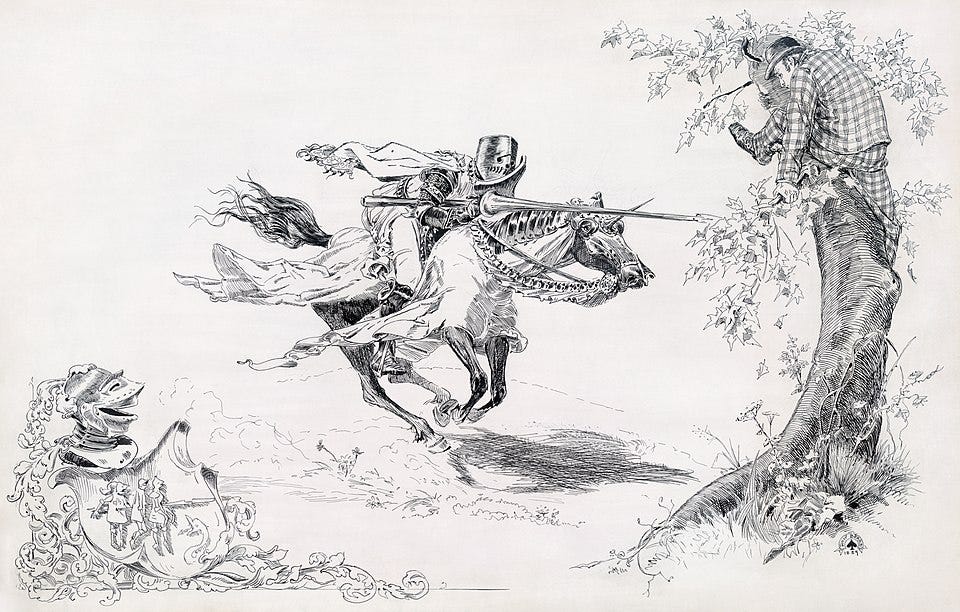
In my reading experience, “career” tends to hold true to its warhorse origins in having something to do with the mass of the thing careering forward. It’s more likely that a rhinoceros will career at Tinkerbell than that Tinkerbell will career at a rhinoceros. If Tinkerbell is the aggressor, which I think is possible, she’s more likely to dart, dash, zip, or zoom.
“Careen” is a good bit more common as a verb referring to motion than “career” is, especially now, and it has to do with watercraft instead of warhorses. A boat can be careened on the beach for repairs to the hull or careened by a wave that makes it heel over. The tilting is the thing, and nonnautical objects can be described as careening when they sway, lurch, or veer. My sense is that “careen” can also describe a vehicle drifting to one side while maintaining its forward movement and staying in line on a stem-to-stern axis—as can turn out well or not well when attempted by Bowser or Princess Peach.
Unfortunately, “careen” has also been used to mean “career,” or rush headlong, for quite a long time, which makes some writers want to give up and careen—or possibly career—off a cliff.
I like both words, though, and will hang on to both of them. If you ever see me hurtling with willful recklessness at a buffet table, I will be careering.
CLICHÉ
Not an adjective among right-thinking people. “That’s so cliché” may be so common that it’s become “so cliché,” but in this case the throbbing in my temples overrules populism.
Even worse when delivered with vocal fry.
DILEMMA
Merriam-Webster dismisses the fusspot’s position that “dilemma” (note the “di”) has to pertain to a situation with two choices, both of which are probably unpleasant. Like the fusspots, though, I refuse to use the word to mean any old predicament, quandary, or pickle. If I’m facing a dilemma, I’m staring down a two-horned choice between the bad and the slightly less bad—and usually having a hard time telling which is which.
I’m with the prescriptivists4 on “dilemma” because I want to honor the “double proposition” etymology of the word, because the choice-of-two meaning makes it clear what I mean when I point out a false dilemma, and because I want to preserve the option of having a precise kind of fun with “trilemma” and “quadrilemma.” There is such a thing as fusspot joy.
ENERVATE
Cruelly, it’s a near antonym rather than a synonym for “energize” and “invigorate.” If my oratory is enervating, my audience is getting sleepy.
Happily, it’s often entertaining when misused.
On July 28 of 2004, during the Democratic Convention, Oscar-winning screenwriter Ben Affleck told MSNBC’s Chris Matthews that John Kerry needed to “enervate the base,” and apparently Senator Kerry was watching Hardball that night.
FEWER / LESS — NUMBER / AMOUNT
With both pairs, the distinction is between the countable and uncountable:
Countable: There are fewer cows in the pasture today.
Uncountable: There is less milk in the carton today.
Countable: The number of ghosts in the cellar is alarming.
Uncountable: The amount of ectoplasm in the cellar is alarming.
The common usage error—although some commentators don’t label it as a definitive error—is to treat a countable thing as uncountable:
Common Error: There are less cows in the pasture today.
Common Error: The amount of ghosts in the cellar is alarming.
The rarely seen usage error—and this time it’s definitely an error—is to treat the uncountable thing as countable:
Uncommon and Very Wrong: There is fewer milk in the carton today.
Uncommon and Very Wrong: The number of ectoplasm in the cellar is alarming.
I don’t take a sip of six milks or get slimed by 12,021 ectoplasms, and for this error, a better designation than “uncommon” might be “effectively nonexistent among native speakers.” You can go a lifetime without hearing someone say, “I will eat fewer ice cream this year.”
I almost always write and edit in keeping with the above. If I come across “There are less benefits to the goat-milk cleanse than some claim,” I will correct it to “There are fewer benefits to the goat-milk cleanse than some claim.”
There are idiomatic exceptions, though, that complicate things with countable nouns:
Mr. Galt refused to accept a ransom of less than three trillion dollars.
This message will self-destruct in less than six seconds.
The Alpha Centauri system is less than five light-years away.
Well that’s one less siege tower we have to set on fire.
There are also occasions when I just don’t care that someone says something like, “Your apartment would be better with less Glade Plugins,” and occasions when I’m fine with good writers using “less” with countable nouns on purpose:
More notes with the phrase “the average Tajik,” less notes without
The above is a Substack note from Philip Traylen, and the chance that he doesn’t know exactly what he’s doing when he uses “less” is exactly zero.5
PRONE / SUPINE
On the belly versus on the back. Snipers are prone. Graceful fainters, grass-nibbling cloud gazers, and this cat are supine.
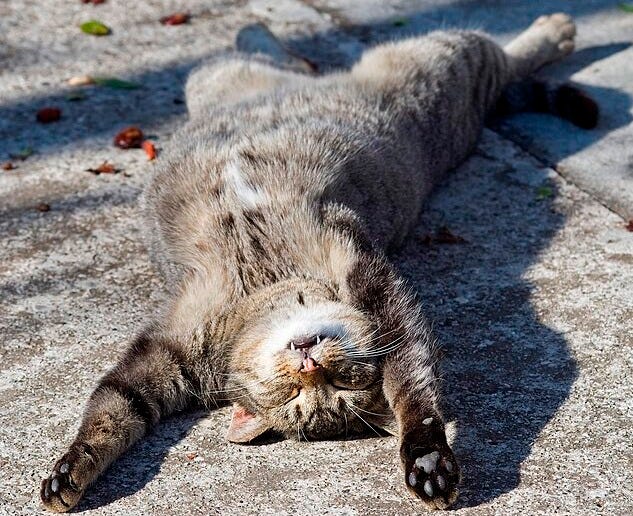
Supine snipers are bad at their jobs. Fainters who end up prone are as graceful as I am.
PROSTRATE
Like “prone,” it has to do with being on your belly, or face-down, but usually connotes being submissive:
Admiral Motti should lie prostrate before Lord Vader.
“Prostrate” can also be a verb, unlike “prone,” and can be used literally or figuratively. You can prostrate yourself by submitting on the actual floor in front of someone, or you can prostrate yourself by assuming a belly-crawling attitude. In modern times, the latter is favored in social and work-related settings to allow onlookers to have plausible deniability about what is happening.
Sometimes the word is misused by gentlemen of a certain age when referring to a type of medical exam.
QUOTATION / QUOTE
When I taught academic writing, I insisted on “quotation” as a noun and “quote” as a verb. I would still do this.
I also reminded my students that they would need to drop this distinction if they ended up in journalism. Telling another journalist you’re about to go downtown to get “a quotation from the mayor” is the equivalent of putting up fencing in the American South and, with deliberate enunciation, asking someone to pass you a roll of “barbed wire.”
The latter is not a good idea unless you’re prepared to dodge an unopened can of Miller High Life.6
THAT’S A GENIUS IDEA!
It isn’t.
If she’s nervous but not excited, I’d revise to “anxious about appearing onstage.”
To further enhance the archetypicality, revise to “Chet and myself are anxious to meet with you tomorrow.”
Before coming up with this list, I failed to appreciate just how fabulous “-el” trochaic verbs are. A novel wherein the characters travel, ravel, gavel, label, libel, shovel, barrel, bevel, tunnel, marvel, grovel, pummel, swivel, drivel, snivel, yodel, and snorkel is a novel that needs to be read.
I wanted to write that I was “with the di-hards on ‘di-lemma’” but decided that no one would like that except for the sort of people who actually bother to read the footnotes.
The choice comes down to a style-and-kairos question, and a prescriptivist nitpick can be as apt as Traylen’s “less notes without.” I was reminded of this watching CNN’s coverage of Times Square, just a few minutes into 2026, when a not-sober B. J. Novak, after hearing a not-sober Andy Cohen twice claim that there were “less rats” in New York City, corrected Cohen with one word: “Fewer.” Having the presence of mind to be a usage scold very late at night while under the influence of tequila surely qualifies as grace under cognitive pressure.
I don’t mean to be mocking here. I have strung barbed wire, and “barb’ wire,” and even “bobwahr,” in the American South and am thankful for the experience.
Gosh, I miss working with you! I really needed your insight, wisdom, and bit of levity today! I especially enjoyed your historical background on career and careen. However, I was delighted to see you address prostrate as it is often misused in medical context. LOL And yes, my great-grandfather and great-uncle put up miles of "bobwahr" over the decades on the family farm in Pearl River County, Mississippi. IYKYK
What a fun and fabulous post! I am now mulling over my double “l”s in expat English and wondering why my British husband tends to reverse emphasise syllables in words without them, like IN-surance or THANKS-giving.
On the less/ fewer point, I notice that many of your exceptions here involve numeric values. I wonder if we mentally put things like minutes and years together as “a group” rather than individually counted items? Do I think of five minutes in the same way as five salt shakers? I don’t think I do. I just think of it as one block of time.