
Ending the "Which" Hunt
Loving writers more than style guides.

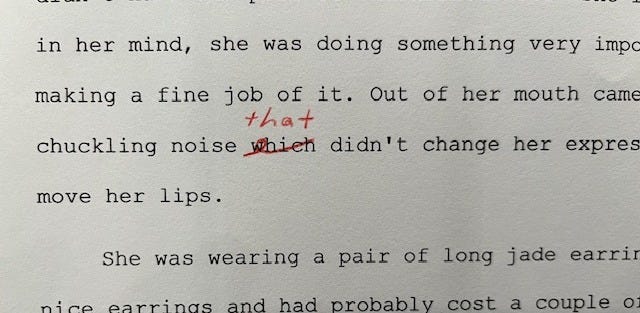
This is going to be a long one, readers, and heavy on language. There’s a usage option wrongly said to be wrong that I mean to set things right about, and there’s some story to it, and there’s a condensed but nutritious grammar review, and there’s a moment when I concede that “which” persecutors have a stylistic point in their favor in certain situations, and there are lots (some will say too many) literary examples, and if all of that sounds just awful, you’ve probably already stopped reading.
If not, read on.
In the United States, many writers are taught to use “which” with nonrestrictive clauses (also called nonessential clauses) and “that” with restrictive clauses (also called essential clauses). The former are set off with commas. The latter are not:
The book, which is awful, lies there menacingly on my nightstand. (nonrestrictive)
The book that is awful lies there menacingly on my nightstand. (restrictive)
The advice about having to use “which” and not “that” with nonrestrictive clauses (the ones surrounded by commas) is good. The advice about having to use “that” and not “which” with comma-free restrictive clauses is not good, despite what some style guides recommend, because it is so poorly grounded in actual English usage. Writers and editors, including many prestige writers and editors who have reputations as grammar sticklers and linguistic grouches, have been using both “that” and “which” with restrictive clauses for centuries.
I confess that for several years I taught freshman comp students to prefer “that” to “which” in restrictive clauses. I didn’t teach this as a rule, much less get snippy about it, but I did teach it as sound usage advice because college handbooks and other sources suggested I should. But the more I looked at the question—and the more I read of everything—the less persuasive the quick-and-easy sources became.
“But what about the Associated Press!” “But . . . The Chicago Manual of Style!”
If you are being asked to follow these style guides without exception or reflection, then by all means follow their advice and prefer “that” to “which” in restrictive clauses. I use both of these style guides professionally, and I especially like The Chicago Manual of Style1. You should be aware, though, that you are following a weakly justified prejudice rather than a rule. If you go a step further and lord your anti-“which” views over others, you’re being an uninformed grammar scold, which is not the right kind of grammar scold to be.
Before I get to the business of maligning beloved style guides, though, we should review some grammar to clarify what restrictive and nonrestrictive clauses are.
Restrictive clauses provide essential information about what they modify and are not set off with commas. Nonrestrictive clauses provide additional information without being essential and are set off with commas.
Restrictive: The button that makes the plane self-destruct is the red one.
Nonrestrictive: This button here, which makes the plane self-destruct, is not the best place to set your thermos.
In the first example, the clause is telling us which button is meant, restricting the meaning of “button,” and in this particular example the clause would seem to be especially essential. In the second example, a clause is again revealing an important piece of information, but the “This button here” suggests that the clause isn’t essential to understanding which button is meant. It’s already understood.
Note that nonessential clauses aren’t confined to situations like the second button example where someone is pointing at something:
Nonrestrictive: The art building, which is the ugliest building on campus, was built in 1971.
This would apply in situations where readers are going to know what is meant by “the art building” without further specification, probably because there is only one art building on campus. Similarly, a farmer’s child who is told to go to “the barn” to get some eggs is not, we hope and believe, likely to dash off to steal eggs from the neighbor’s barn. The farmer’s family knows that “the barn,” in isolation, means the big brown wooden structure out back.
As for when to use “that” and “which,” one thing that all reasonably sober editors agree on is that using “that” with nonrestrictive clauses is an error:
ERROR: The art building, that is the ugliest building on campus, was built in 1971.
FIXED: The art building, which is the ugliest building on campus, was built in 1971.
“That” has been used in nonrestrictive clauses historically, but it’s rare in recent centuries.
What American editors argue about is whether the following is wrong:
A common violation of conciseness is the presentation of a single complex idea, step by step, in a series of sentences or independent clauses which might to advantage be combined into one.
The “which” clause is clearly restrictive. The author of the sentence is American and thus would be subject to the same Yankee Doodle usage as The Chicago Manual of Style and the Associated Press. (Editors of British English, being fortunate, will see no reason to change “which” to “that” here.) Clearly, then, the author using “which” when “that” is the correct choice must either be uninformed about American usage or a dangerous scofflaw.
The author, though, is William Strunk, Jr., an English professor at Cornell and author of the original The Elements of Style (1918), from which the sentence above was taken. Strunk is sometimes criticized, and sometimes savagely, but criticism of him almost always comes from people who think he is too rigid and rule-oriented, not from purists who mistake him for a scofflaw.
A famous student of Strunk’s, E. B. White, would later revise The Elements of Style to insist that “that” be used with restrictive clauses, but he was following a mid-century editorial drift in favor of the practice while ignoring how writers and teachers like Strunk actually used “which.”
E. B. White was also ignoring how E. B. White used “which”:
I have since become a salt-water man, but sometimes in summer there are days when the restlessness of the tides and the fearful cold of the sea water and the incessant wind which blows across the afternoon and into the evening make me wish for the placidity of a lake in the woods.
It is strange how much you can remember about places like that once you allow your mind to return into the grooves which lead back.
I did not spend an afternoon scouring E. B. White essays in search of reckless illiteracies. Both sentences came from the first White piece I looked at, “Once More to the Lake,” which is probably his most widely anthologized essay and one of the great American essays of the last century. The offending “which”es can be found in the first and second paragraphs.
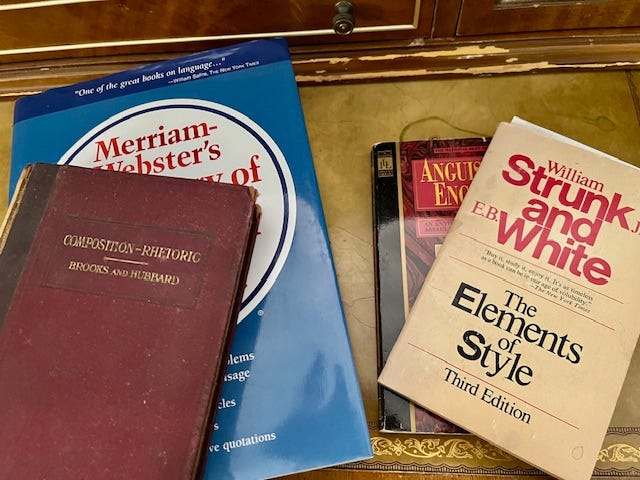
Why, then, did White himself later start recommending saving “which” for nonrestrictive clauses and insisting on “that” with restrictive clauses?
Merriam-Webster’s excellent page on the subject points, as others have, to The King’s English (1906), by H. W. and F. G. Fowler, which suggests not using “which” with nonrestrictive clauses unless “custom, euphony, or convenience is decidedly against the use of that.” The Fowler brothers don’t provide much of a rationale for saying that “which” should be reserved for nonrestrictive clauses, and their three-part escape clause of “custom, euphony, or convenience” suggests that they’re not especially confident with whatever their rationale is. A review of “custom” before 1906 suggests that their advice should have been declared dead on arrival.
H. W. Fowler returned to the subject in A Dictionary of Modern English Usage in 1926—his brother having succumbed to tuberculosis in 1918—and fleshed out the Fowler anti-“which” view:
. . . if writers would agree to regard that as the defining [i.e., restrictive] relative pronoun, & which as the non-defining [nonrestrictive], there would be much gain both in lucidity & in ease. Some there are who follow this principle now; but it would be idle to pretend that it is the practice either of most or of the best writers.
The rationale is still weak. English speakers aren’t confused by sentences like the sentence which I’m currently writing, so “lucidity” isn’t persuasive. People have heard restrictive clauses begin with “which” for centuries without showing signs of fatigue, so “ease” isn’t persuasive. The fact that “the best writers” don’t practice what Fowler is preaching is a problem. That “most” don’t practice it is a catastrophe.
The implicit appeal seems to be to logic. Wouldn’t it be neat if we had a clear distinction between “which” and “that”? I can see why someone might think this. The problem, though, is that when the distinction is codified into a rule, as the “that”/“which” distinction effectively has been in some style guides and handbooks, (1) the history of English usage is grossly misrepresented and (2) many writers and editors will forget that “which” can sometimes be the better choice for reasons of “custom, euphony, or convenience,” as was originally pointed out by the siblings who initiated this whole fiasco.
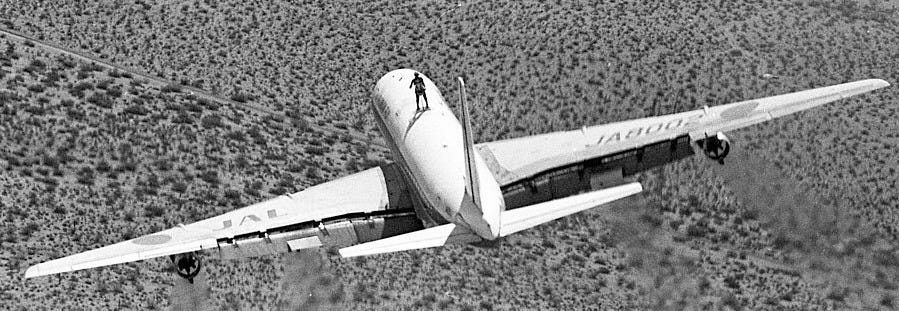
The assumption that the English language should be logical is endearing but erroneous. Getting “on” the plane when I fly to Seattle isn’t logical. If the preposition is literally accurate, meaning that I’m standing atop the fuselage of a 737 at LaGuardia, knees slightly bent, poised for takeoff, it’s madness. It’s far safer to get in the plane. And yet millions of English-speaking travelers “get on the plane” every day. Imposing an ad hoc conception of logic or rationality on language (or whatever other soon-to-be-damned thing) was an idea that was eminently of the moment in 1906, and to an extent it still is, but an idea can be of the moment and yet wrong.
Despite the Fowlers’ poor arguments and fatal qualifications, many American editors began to adopt their recommendation later on in the twentieth century. The editors at Harper’s didn’t insist on “that” in White’s “Once More to the Lake” in 1941, as quoted above, but a hard preference for “that” with restrictive clauses eventually became the standard in The New Yorker and has been in effect in AP style since at least the 1970s. In my experience, some copyeditors who default to AP think that writers who sometimes use “which” with restrictive clauses are being ungrammatical, which is a mind-boggling position if you have read a decent amount or are aware of the existence of English outside of the United States.
And still the “which” hunt continues with almost zero understanding of how aspirationally it began back when the Fowler brothers were practically humming “wouldn’t it be nice” along with the Beach Boys.
Plenty of good writers knew writing too well to go along with the editorial fad as it took root. And some of them were better than merely good. Here is Joan Didion in 1967’s “Goodbye to All That,” published in The Saturday Evening Post:
When I first saw New York I was twenty, and it was summertime, and I got off a DC-7 at the old Idlewild temporary terminal in a new dress which had seemed very smart in Sacramento but seemed less smart already, even in the old Idlewild temporary terminal, and the warm air smelled of mildew and some instinct, programmed by all the movies I had ever seen and all the songs I had ever heard sung and all the stories I had ever read about New York, informed me that it would never be quite the same again.
There are at least a half a dozen more restrictive uses of “which” later on in the essay, even if none of those sentences measure up to quite the same level of sad, wisecracking gorgeosity as this one.
Didion was still at it a dozen years later, only a few sentences into the title essay in The White Album:
We live entirely, especially if we are writers, by the imposition of a narrative line upon disparate images, by the "ideas" with which we have learned to freeze the shifting phantasmagoria which is our actual experience.
This is well into the “which”-hunting era in journalism, but Joan wasn’t joining the mob.
And she is not alone in her refusal among good American writers. Jill Lepore, an academic who writes prose fit for humans and lovers of language instead of academic esotericists, managed to sneak a restrictive “which” past the editors at The New Yorker within the last decade:
By 1969, relying on a data-transmission technology called “packet switching” which had been developed by a Welsh scientist named Donald Davies, ARPA had built a computer network called ARPANET. (“Can the Internet Be Archived,” 2015)
So bravo to Dr. Lepore.
James Gleik allows himself two instances of a restrictive “which” in his book on Richard Feynman, though on both occasions he seems to take comfort in a nearby comma:
Even so he had to adjust to a place which, even more than Harvard and Yale, styled itself after the great English universities, with courtyards and residential “colleges.”
He now spent much of his time writing screeds on world government which, from a less revered figure, would have been thought crackpot. (Genius: The Life and Science of Richard Feynman, 1993)
Gleik’s book is a revealing case in point because it contains a lot of interview material and other kinds of quotes, and this language is rich with restrictive uses of “which.” Even though the book has clearly been edited by “which”-hunters given its strong preference for “that,” its quoted passages provide overwhelming evidence that actual American usage doesn’t reflect an anti-“which” bias. Given that the book focuses on Feynman and friends, and unfriends who also tended to be terribly smart, it’s difficult to argue that the usage is nonstandard or the product of grammatical ignorance.
So is there anything to be said for following the recommendations of the Associated Press and The Chicago Manual of Style?
There is a circular appeal. If you prefer following the recommendations, then follow the recommendations. A less tautological version of this appeal would be to follow the recommendations because they are in the preferred style guide of a particular organization or client. I’ve done that myself many times. It’s perfectly fine even though it does nothing to speak to the ultimate ought question regarding writing well.
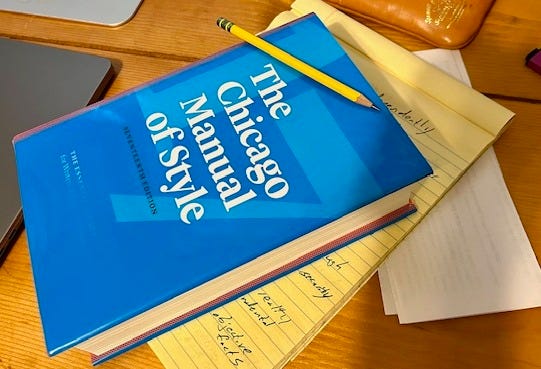
There are also appeals to fear. You might avoid using the restrictive “which” if you think someone is going to judge you, berate you, fire you from your copyeditor job, or throw The Chicago Manual of Style in your direction. (My 17th edition weighs in at over two pounds and is quite dangerous.) I am all for pointing out that people who demand that we correct a restrictive “which” to “that” on historical or grammatical grounds are wrong to do so, especially if they’re malicious about it, but I don’t want anyone to lose a job or gain a concussion.
Beyond “I prefer X because I prefer X,” “the written regs are right because the written regs are right,” and “please don’t hurt me”—which add up to two fallacies of begging the question and one argumentum ad baculum (the “appeal to the stick” fallacy)—there is a stylistic argument for preferring “that” to “which” in certain circumstances.
“Which” can seem more formal than “that” sometimes. And sometimes it can seem too formal. For example,
I never saw the car which hit me.
The main thing which gets on my nerves is your breathing.
It’s the bingo which makes Tuesdays so exciting.
Sentences like these can have the feel of a conversation with someone who never uses contractions: “I am glad that you have come to my birthday party. We are going to have a good time.” If you’re avoiding “which” because it seems too stiff for the moment, then by all means use “that.”
But the indiscriminate persecution of restrictive “which”es needs to stop. English-speaking journalists, editors, and writing students don’t need to be miseducated about the history of their language and literature. They shouldn’t be persuaded by the Fowlers’ bad arguments, much less by the transformation of their heavily qualified “if only people wouldn’t do this” into a “thou shalt not.”
Consider who would be bad practitioners of English in retrospect. Hamlet uses “which” restrictively at Ophelia’s graveside at the culmination of a complicated joke involving dead lawyers, parchment, sheepskins, and calfskins in the first scene of Act V:
They are sheep and calves which seek out assurance in that.
Set aside for now that the joke is of the “you had to be there” variety. Instead, focus on the fact that in this line Prince Hamlet, eloquent and brilliant as he is, might be accused of making his listeners weary and confused by those who have drunk too deep from The Associated Press Stylebook.
Still in the first scene of Act V, Hamlet continues with “which” in a more famous passage about the human body’s return to dust after death, to dirt which can be put to humble uses, which was as true for Caesar and Alexander as it will be for us all:
Imperious Caesar, dead and turn’d to clay,
Might stop a hole to keep the wind away.
O, that that earth which kept the world in awe
Should patch a wall t’expel the winter’s flaw.
The line in question reminds us that “which” can be useful in preventing a sentence from being overcome with “that.” A revision to “O, that that earth that kept” would be a bad move.
It’s not just Hamlet who gives us reason to love the restrictive “which.” And not just Shakespeare. And not just non-Americans. In the list below I’ve oversampled American writers so as not to make my list-making too easy:
Is this a dagger which I see before me,
The handle toward my hand? (Macbeth, II.i.)
The gentlemen pronounced him to be a fine figure of a man, the ladies declared he was much handsomer than Mr. Bingley, and he was looked at with great admiration for about half the evening, till his manners gave a disgust which turned the tide of his popularity; for he was discovered to be proud, to be above his company, and above being pleased. (Jane Austen, Pride and Prejudice)
Divine justice pursued its course; disasters came thick on me: I was forced to pass through the valley of the shadow of death. His chastisements are mighty; and one smote me which has humbled me forever. (Charlotte Bronte, Jane Eyre)
It is for us the living, rather, to be dedicated here to the unfinished work which they who fought here have thus far so nobly advanced. (Abraham Lincoln, The Gettysburg Address)
Is it a cheap shot to use Lincoln and this most American of documents? Maybe. I’m not going to lose sleep over it, though, and I think a revision to “that” would do some harm to euphony as well.
Herein lie buried many things which if read with patience may show the strange meaning of being black here at the dawning of the Twentieth Century. (W. E. B. Du Bois, the first sentence of The Souls of Black Folk)
This responsiveness had nothing to do with that flabby impressionability which is dignified under the name of the “creative temperament.” (F. Scott Fitzgerald, The Great Gatsby)
Krebs went to the war from a Methodist college in Kansas. There is a picture which shows him among his fraternity brothers, all of them wearing exactly the same height and style collar. He enlisted in the Marines in 1917 and did not return to the United States until the second division returned from the Rhine in the summer of 1919.
There is a picture which shows him on the Rhine with two German girls and another corporal. (Ernest Hemingway, “Soldier’s Home”)
She got so she received all things with the stolidness of the earth which soaks up urine and perfume with the same indifference. (Zora Neale Hurston, Their Eyes Were Watching God)
They spurned and were terrified of the darkness, striving mightily for the light; and considered from this aspect, Miss Ophelia's exclamation, like Mrs. Stowe's novel, achieves a bright, almost a lurid significance, like the light from a fire which consumes a witch. (James Baldwin, “Everybody’s Protest Novel”)
Baldwin is so comfortable with “which” he isn’t worried about the homophone that concludes the sentence.
I was looking for myself and asking everyone except myself questions which I, and only I, could answer. (Ralph Ellison, Invisible Man)
And then the voices began and they were talking, and he could hear nothing of what the voices said, but the sound rose and fell quietly and the voices were turning the world over and looking at it; the voices knew the land and the trees and the city which lay down the track by the river. (Ray Bradbury, Fahrenheit 451)
He taught Russian at Waindell College, a somewhat provincial institution characterized by an artificial lake in the middle of a landscaped campus, by ivied galleries connecting the various halls, by murals displaying recognizable members of the faculty in the act of passing on the torch of knowledge from Aristotle, Shakespeare, and Pasteur to a lot of monstrously built farm boys and farm girls, and by a huge, active, buoyantly thriving German Department which its Head, Dr. Hagen, smugly called (pronouncing every syllable very distinctly ) “a university within a university.” (Vladimir Nabokov, Pnin)
Nabokov’s “which” slows the sentence down ever so slightly, getting us ready for the deliberate syllabification of Dr. Hagen.
The only other address I had was the innocuous box number which people used who didn't want to advertise the fact they lived in an asylum. (Sylvia Plath, The Bell Jar)
Simply, there are swamps which contain a large percentage of sulphur and other gas bubbles that burst continually into flame. (William Goldman, The Princess Bride)
A pool room always was a place which caused people to cluck their tongues upon mention. (Jimmy Breslin, “All-Time Champ”)
If a cigar-smoking, hard-drinking newspaper guy like Jimmy Breslin can use a restrictive “which” while writing about a pool hall, the Associated Press can stop worrying that American journalists who do the same will be putting on airs.
I was in a French train with Renata, taking a trip which, like most trips, I neither needed nor desired. (Saul Bellow, Humbolt’s Gift)
Using a camera appeases the anxiety which the work-driven feel about not working when they are on vacation and supposed to be having fun. (Susan Sontag, On Photography)
Her book was a volume of English history illustrated with a few drawings which she pointed out to me. (Octavia Butler, Kindred)
The guards weren’t allowed inside the building except when called, and we weren’t allowed out, except for our walks, twice daily, two by two around the football field which was enclosed now by a chain-link fence topped with barbed wire. (Margeret Atwood, The Handmaid’s Tale)
It is not flawed choice, flawed action, or even death itself which is the ultimate human dilemma. (Camille Paglia, Sexual Personae)
Abruptly she stopped answering Sabbath’s phone calls, and when he ran into her one day—while he pretended to be studying the window display of the gourmet shop, a display which hadn’t changed since Tip-Top Grocery Company had evolved in the late sixties into Tip-Top Gourmet Company to accommodate the ardor of the times—she said to him angrily, her mouth so minute it looked like something omitted from her face, “I don’t want to talk to you anymore.” (Philip Roth, Sabbath’s Theater)
If Roth can pull off this sentence and the brilliant anticlimax at the end, we should agree that editors who attempt to improve it with “that” should have their pencils taken away.
Enid and Alfred had many afflictions which they believed to be extraordinary, outsized—shameful—and the crickets were one of them. (Jonanthan Franzen, The Corrections)
The first [book I wrote] was about Slonim, the town where I lived which was sometimes Poland and sometimes Russia. (Nicole Krauss, The History of Love)
In what seemed even to me a doomed and Pyrrhic gesture, I switched to English literature without telling my parents. I felt that I was cutting my own throat by this, that I would certainly be very sorry, being still convinced that it was better to fail in a lucrative field than to thrive in one that my father (who knew nothing of either finance or academia) had assured me was most unprofitable; one which would inevitably result in my hanging around the house for the rest of my life asking him for money; money which, he assured me forcefully, he had no intention of giving me. (Donna Tartt, The Secret History)
Let’s end our journey Tartt-ly, then, with an English major from Mississippi who didn’t end up “hanging around the house” and who knows English too well to surrender to ill-conceived writing advice. Although I don’t know Donna Tartt’s precise feelings about style guides, I do know that she can craft sentences which should make us treat the advice of style guides, including the AP Stylebook and first-rate resources like The Chicago Manual of Style, as situational conventions rather than holy writ.
CMOS’s discussion about the restrictive “which” is evenhanded in its coverage of commas with relative clauses: “Although which can be substituted for that in a restrictive clause (a common practice in British English), many writers preserve the distinction between restrictive that (with no commas) and nonrestrictive which (with commas).” The section on problematic words and phrases, however, presents sticking to a strict “that”/“which” distinction as the clear choice of the knowledgeable and the righteous: “The language inarguably benefits from having a terminological as well as a punctuational means of telling a restrictive from a nonrestrictive relative pronoun, punctuation often being ill-heeded.” A fascinating thing about this micro-argument is that the most pompous word in it, “inarguably,” is also an admission of weakness.
Joan Didion said somewhere that she did not know any formal rules of grammar. She wrote by ear. It worked for her!
Coming to this a bit late in the day! Sometimes it is absolutely necessary to use 'which'. The following sentence caused a slew of problems and confusion when it appeared in a post on Academia Stack Exchange:
- If the professor is an IEEE member then they signed an ethics statement and are subject to IEEE censure. IEEE has a way to denounce someone that protects the whistle-blower.
The problem is the structural ambiguity concerning the relative clause "that protects the whistle-blower". Does it modify the noun phrase "a way to protect someone" or does it modify the smaller noun phrase functioning as the object of the verb "protect", i.e "someone"? When read the wrong way, it sounds as if IEEE wants to punish people who protect whistleblowers. The author here has obeyed, consciously or otherwise, the mythical rule stipulating the use of "that" and not "which" in restrictive relative clauses. The ambiguity could easily be cleared up, of course, by using "which", incompatible with an animate "someone" antecedent.